

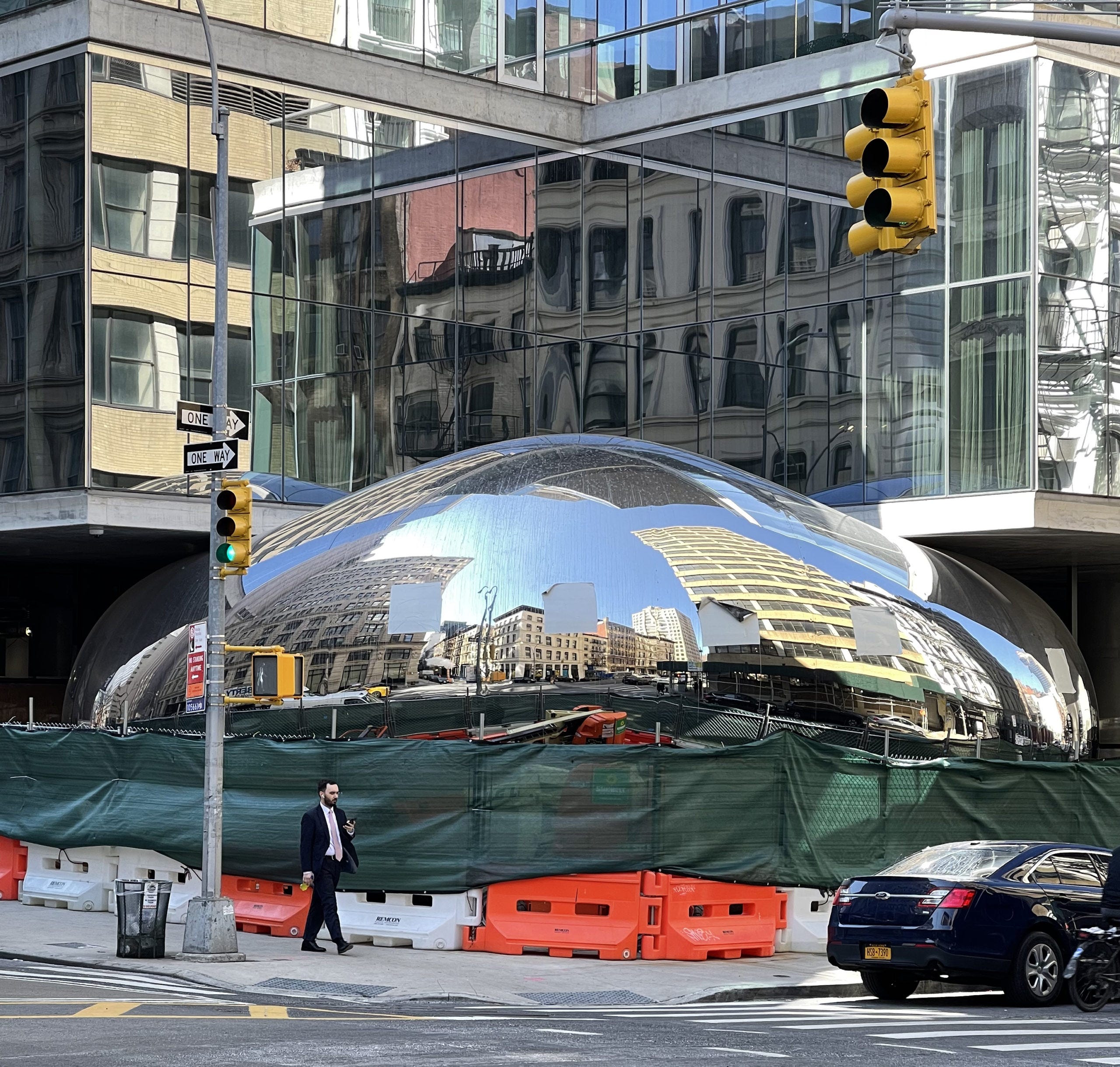
A year ago, the first outdoor sculpture in New York by the artist Anish Kapoor was unveiled at 56 Leonard Street, at the intersection of Leonard and Church Street in Tribeca, to a somewhat indifferent public. The collective shrug, which resonated throughout both arts and city reportage, was rather surprising: in one sense, because this was a major public sculpture produced by a major contemporary artist, subject to a long period of gestation, and, in another, because the sculpture itself was startlingly conspicuous – a massive, mirrored form visible from several blocks away. Yet a sort of bland innocuity, something reminiscent of the museum gift shop, clung to the sculpture, as would the imprints of grubby hands and a chalky efflorescence left by rain. A naming ceremony was announced at the time, but it never took place. In the months that followed, the sculpture was spared not only a name, but also any attempt to make sense of it, even the usual, hand-wringing concerns about art thrust upon an undesiring, unwelcoming public – a time-honored New York tradition.
Perhaps it was because the sculpture drew upon another New York tradition – namely, the import of pre-fabricated cultural signifiers from elsewhere – and arrived with a built-in sense of familiarity. For many, the nameless Kapoor recalled the artist’s earlier Cloud Gate, 2006, the centerpiece of Chicago’s Millennium Park, widely considered the first great triumph of public art in this century. Cloud Gate, more commonly known as “the Bean,” after its leguminous form, combined a certain overture to civic optimism with an appeal to the then-burgeoning experience economy– meaning that you could take pictures in its reflective surface. Unlike Millennium Park’s other major public artwork, Jaume Plensa’s haunting Crown Fountain, a permanently looming video installation composed of spitting Chicagoans, Cloud Gate seemed to consciously insert itself into a lineage of public art as civic symbol, formally evoking St. Louis’ definitive Gateway Arch, 1967, designed by Eero Saarinen.
Although Cloud Gate was unveiled belatedly, two years after the opening of Millennium Park, it still seemed to have materialized spontaneously, like a drop of mercury spilled by God. In contrast, the New York sculpture emerged slowly, fitfully, with the entire city witness to its awkward, intermittent production. Construction began in 2019, two years after the completion of 56 Leonard, the skyscraper that occasioned its commission. It was then stalled by the pandemic and the consequent visa issues incurred by Kapoor’s UK-based team, who were unable to enter the United States. After construction resumed, in the summer of 2022, another mishap came when one of the sculpture’s steel plates ruptured in the heat of the sun, resulting in another delay. It was during this long period that people began taking photos of the unfinished work – “one part reflective mirror, one part boarded-up abyss,” per Sophie Haigney, in her coverage for Curbed – and it was christened the Half-Bean. This moniker has endured, perhaps due to the work’s diminutive relationship to the original. (In actuality, the New York sculpture is scaled to around 70 percent of Cloud Gate’s dimensions in width, and 60 percent in height, so it is now closer to call it the Two-Thirds Bean.) In the end, roughly six years passed between the completion of 56 Leonard and that of the beleaguered New York sculpture. When the sculpture revealed its final form, it at last appeared to provide some sort of structural corrective to the high-rise towering above it, wedged humorously, as it was, under 56 Leonard, like a fistful of napkins beneath a wobbling table.
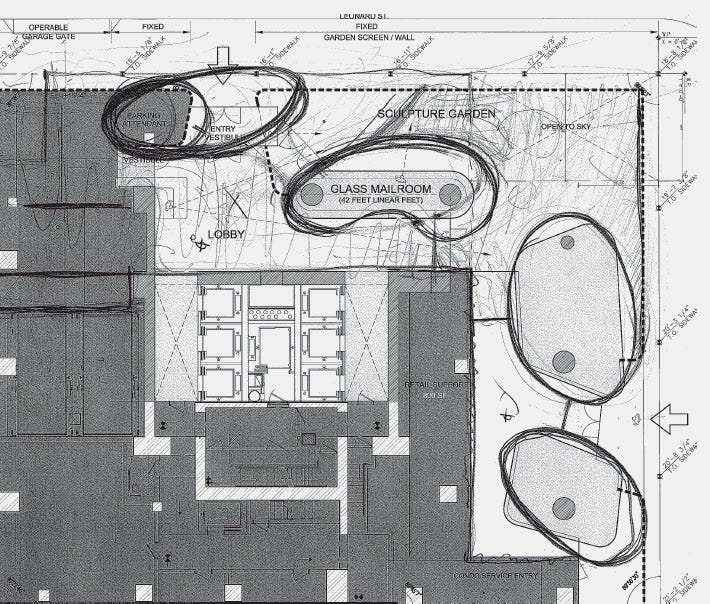
The wobbling table was designed by Herzog & de Meuron, the Swiss architecture firm also responsible for Basel’s Roche Towers and the Beijing National Stadium, as a kind of monument to precarity. The property was purchased by the real estate developer Izak Senbahar soon before the financial crisis of 2008 and, whether deliberate or not, its design remains mired in the operative logic of historical circumstance. Colloquially referred to as the “Jenga Tower,” for its resemblance to the game of building blocks, the building was intended to formally invert the conventions of the traditional skyscraper, overtly envisioned to produce a novel symbol for the otherwise barren skyline of Tribeca. Yet for the first forty-five floors, it conforms to the conventional structure, differentiated only by the irregular positioning of ledges and balconies. The true inversion resides in the residential units constructed above the forty-sixth floor, rather ominously referred to, by Herzog & de Meuron, as “sky villas,” which teeter in place of the New York skyscraper’s ornamental ziggurat. Against the crowning assuredness of the tapered ziggurat, it is the off-kilter arrangement of the “sky villas” that produces a sense of unease that infects the whole building, when seen from a distance, on the street. What is strange about this design is not only its evocation of imminent collapse, in the post-9/11 landscape of New York, but also the extent to which it seems to align with contemporaneous literature, then popular in art and architecture circles, surrounding the intersections of urban planning, gentrification, and post-Fordist precarity. The illusion of structural precarity engendered by Herzog & de Meuron’s design, however, does not refer back to the situation of the middle-class creative precariat, as much of that literature had, but rather to the far more dramatically shifting fortunes of the firm’s intended audience – CFOs embroiled in alleged pump-and-dump schemes, crooked art advisors, and reclusive pop stars, or, in other words, the buyers of 56 Leonard.
In its pointed reimagining of the classic New York form, the firm seems to have considered Rem Koolhaas’ fundamental study Delirious New York, 1978, as well. But rather than Koolhaas’ notion of the “suicide pinnacle,” the concept 56 Leonard furtively reimagines, it is their fellow architect’s articulation of the “city within a city” through which Herzog & de Meuron have publicly framed their design. (Koolhaas’ firm Office for Metropolitan Architecture has also toyed with the image of imbalanced verticality, as in their project de Rotterdam, completed in 2013.) In the words of Gerhard Mack, for instance, writing for the architects’ catalogue raisonné, the firm’s high-rises “are designed as vertical cities, with an outward appearance based predominantly on the movements and spatial clusters that enhance the functionality of the building in the interests of the client.” (Form follows client demand.) On 56 Leonard in particular, Mack notes that, “ultimately the form is determined by individualistic apartments and almost dissipates in an accumulation of precarious balances. It would hardly be possible to more dramatically demonstrate the interplay of individuality and community that defines society today.” While the more political dimensions of this top-heavy “interplay” are left to the imagination, some of the more menacing associations conjured by 56 Leonard have still crept into the firm’s public statements surrounding the project. “If you make the upper box, let’s say, hover to a certain degree, you don’t make it hover so it collapses,” Jacques Herzog explained, on a television show. “You can push it to an extreme, like in Chaplin’s movie, you know, where this house, always, is on the verge of falling down.” Of course, in the comic sequence of Charlie Chaplin’s The Gold Rush, 1925, the little Alaskan cabin slips, slides, and teeters on the edge of a precipice, before, indeed, it goes tumbling down.
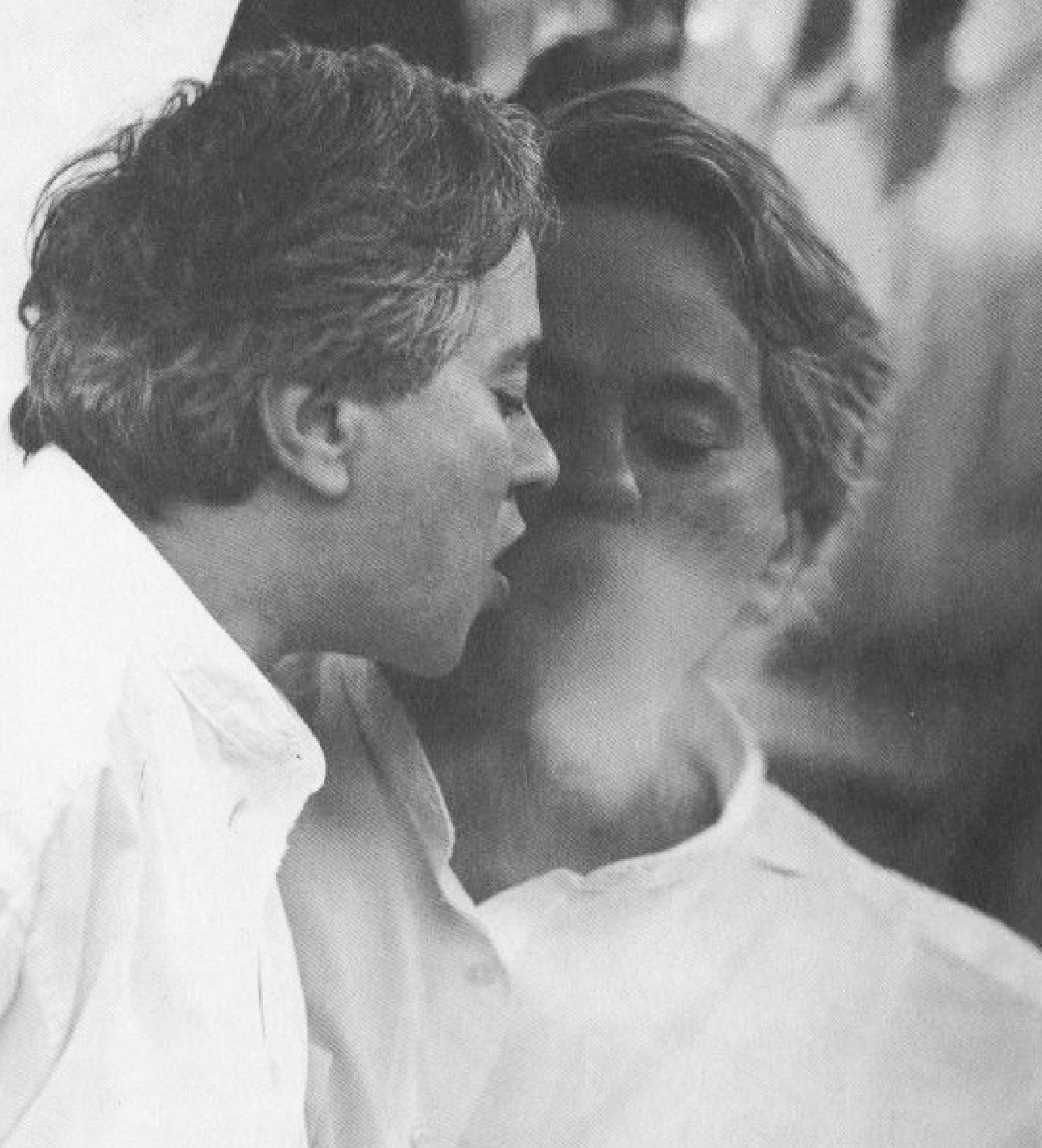
Jacques Herzog and Pierre de Meuron have mostly avoided the authorial signature sustained by their fellow generational cohort of starchitects – think of Tadao Ando, Santiago Calatrava, or the late Zaha Hadid – in order to work situationally, commission-by-commission, in the material-subverting lineage of Joseph Beuys, with whom they once made felt suits for a carnival parade, and the spatially-conscious modality of Donald Judd. From the beginning of their professional partnership in the late 1970s, the triangulation of these two distinct approaches toward sculpture has served as a means of eluding any programmatic framework for architecture. Simultaneously, the firm has often conscripted contemporary artists to supply the signature missing from their own work. They have brought in artists like Thomas Ruff, Rosemarie Trockel, and Andreas Gursky, and have cultivated sustained relationships with the late Rémy Zaugg, with whom they collaborated from the 1980s until Zaugg’s death in 2005, and Ai Weiwei, with whom they began working in 2002. While these collaborations were often marked by a spirit of integration, the Kapoor sculpture has more frequently been perceived as a superfluous addition, like an eight-million dollar bauble demanded by Senbahar personally, out of vanity, rather than a predetermined feature of 56 Leonard’s design. For indiscernible reasons, Senbahar has played up this confusion in the press. When asked by New York magazine, for example, why he would sink so much time and money into the sculpture, the developer responded, “The bankers have asked me that. So have my partners… Look, you can’t analyze everything on a spreadsheet.”
Perhaps not, but look toward 56 Leonard itself, which suggests that its stability rests upon the base support provided by Kapoor. Stationed between the private space of the residential skyscraper and the public arena of the street, the commission itself remains somewhat open and indefinable: neither an autonomous sculpture nor an architectural feature, neither a public sculpture, in the traditional sense, nor a mass spectacle. Of course, it engages with all of these categories, but exists primarily between them. In that sense, the sculpture is ultimately only fully an Anish Kapoor, nameless aside from the name of the author affixed to it, a signature scrawled upon 56 Leonard’s foundation. Which is also, of course, its central purpose – to provide the reassuring force of cultural capital accumulated through recognition of the artist’s name, confirmed by each image captured in the sculpture’s polished façade.
Kapoor himself has become such a ubiquitous feature of the contemporary landscape that he has paradoxically become difficult to grasp. The pseudo-mythical narrative of his artistic development, of his brief return to India and rediscovery of South Asian culture following his sculptural training in London, which once stifled the literature surrounding him, has long been occluded by his enduring appearance as a blue-chip, celebrity artist, a smiling face of the Commonwealth, and as a name familiar to a large number of people otherwise disengaged from the whirring discourse of contemporary art. In the present text, a better point of entry may be an early drawing, Circle to Square Drawing, 1973, which was produced mechanically, rendered by instructing a computer graphics program to turn, as its title suggests, a circle into a square, rendered in a gradual, horizontal array. The irregular shapes in between those dictated by Kapoor were the ones that interested him – they were the forms generated, one might say, by the software program’s imagination, by a rudimentary form of artificial intelligence. This is the artwork Kapoor claims as his first, and it’s not hard to comprehend why. The novelty of form, the plugging in of variables (whether culturally-evocative materials or architectural dimensions), and the delegation of artistic execution (whether to a software program or a team of trained assistants): these are both the components that have come to form the armature of Kapoor’s practice and the process through which the artist has produced a sort of global style for contemporary art alongside its development in architecture. It makes sense here, too, that one of the paramount concerns of the artist’s oeuvre has been the sensorial relationship between the embodied spectator and the architectural frame, a sense of estrangement enabled readily by the machine, if not also by a large production budget.
A fixture of the 1990s, Kapoor and his attendant success came to confirm a return to the body and physical encounter in that decade, after its displacement by relatively incorporeal concerns – text, image, appropriation, semiotics – in the 1980s. Following his rise to prominence, marked roughly by his inclusion in the 1990 Venice Biennale, Kapoor began producing the reflective sculptures in polished steel for which his practice has perhaps become best known. The early versions of these works were shown in galleries, at a relatively approachable scale, and conformed to a limited array of titles: Turning The World Inside Out, Turning the World Upside Down, Making the World Many. As with many of Kapoor’s works, the titles are deceptively simple, and do more for the work than their plainness initially indicates. We might say that the gerund verb-form initiating each suggests a present-tense action staged on the world, the whole world, not just the white cube in which the works were installed, which, alongside their serial application, grants the sculptures themselves some relation to a magic act – a set illusions that may be performed repeatedly. And in some sense, they were magical, or at least beguiling, and definitely not a party trick. We expect the mirror to reverse or perhaps distort, but not to turn our image 180 degrees, tessellate it, or turn us into many, at least not like that, and the experience of standing before one of Kapoor’s strange works begins to transcend rational explanation. In that way, they also elegantly fulfilled Kapoor’s oft-quoted, earlier statement of intention: “I wish to make sculpture that is about belief, or about passion, about experience that is outside of material concern.” Losing oneself in the phenomenological aspects of these works, it’s easy to understand what he meant, and to believe him.
The high-mindedness of this sentiment, however, stands in obvious conflict with Kapoor’s mainstream reception, which the artist has evidently courted in the latest chapter of his career. In an incident seemingly calculated to provoke, he garnered attention in 2014 for gaining exclusive artistic license to Vantablack, an engineered super-black pigment that absorbs almost all visible light. Further on the intellectual property front, he has waged public legal battles against the National Rifle Association and the city of Karamay, a Chinese oil town, over the use and appropriation of Cloud Gate’s likeness. In the museum gallery, he has become known for installing death traps for the elderly, like Descent into Limbo, 1992, an eight-foot hole in the ground that sent one viewer to the hospital during its presentation at Fundação de Serralves in Porto, in 2018. That same year, he designed an ugly statuette for the Brit Awards. While some of these incidents may have been inescapable (it is not necessarily Kapoor’s fault what happened to that man in Porto), their overarching atmosphere of bombast and, yes, “material concern,” has seeped into his artistic practice, as well. More recent works, dating perhaps to Shooting into the Corner, 2009-2013, a cannon programmed to ejaculate canisters of blood-red wax onto a museal wall, seem to cultivate an ambience of flaccid controversy under the guise of unfettered ambition. In the cynic’s reading, such stunts may distract from the suspicion that Kapoor has become a market artist around whom a sense of market fatigue seems to hover, an impression supported by the moniker once appended to him by a dealer, in the journalist Georgina Adam’s account: “the Pottery Barn of Void.” Yet even as Kapoor has participated in some of the more contradictory impulses of the global art market, he has also evinced a healthy skepticism for public art in general. “I have a great problem with public sculpture,” he once said. “Public sculpture is something that doesn’t easily work. It doesn’t easily work, in my opinion, because, in a sense, the philosophical reasons for it being out in the public are eroded. So the work needs to re-establish why it’s out there. There’s no point in clunking a thing in front of an office building, or whatever it is. It’s purposeless.”
What the commodified artwork shares with public sculpture is a tenuous investment in the future. Just as the collector awaits the day her acquisition will accrue a little more value, so, too, does the governmental agency or private corporation foisting bad new objects onto an unsuspecting public. Or so it seems, if we are to agree with the definition of public sculpture that opens Aloïs Riegl’s 1903 essay “The Modern Cult of Monuments”: a work “erected with the precise intention of keeping particular events or human achievements alive in the consciousness of future generations.” This is also the definition of public art the curator Jean de Loisy claims Kapoor’s mirrored forms deviate from in their commitment to a “transitory ‘now.’” But isn’t it exactly in their commemoration of presentism, transience, placelessness, and the public image-economy, all prominent features of the contemporary, that Kapoor’s reflective monuments conform to the conventional purpose of public sculpture? Don’t these works indeed “re-establish” Riegl’s purpose for a global public that no longer finds value in monuments dedicated to historical events or individuals like Reynolds and Balzac? Seen as a memorialization of the present, these works gamble that what seems innocuously contemporary today will, through time, accumulate a different form of currency, what Riegl referred to, in the same essay, as “historical value.” The inevitable end of their “transitory now”-ness and their future value as historical artifact is already anticipated in the act of installing them, likely permanently, outside, in the diminished public sphere of the twenty-first century metropolis.
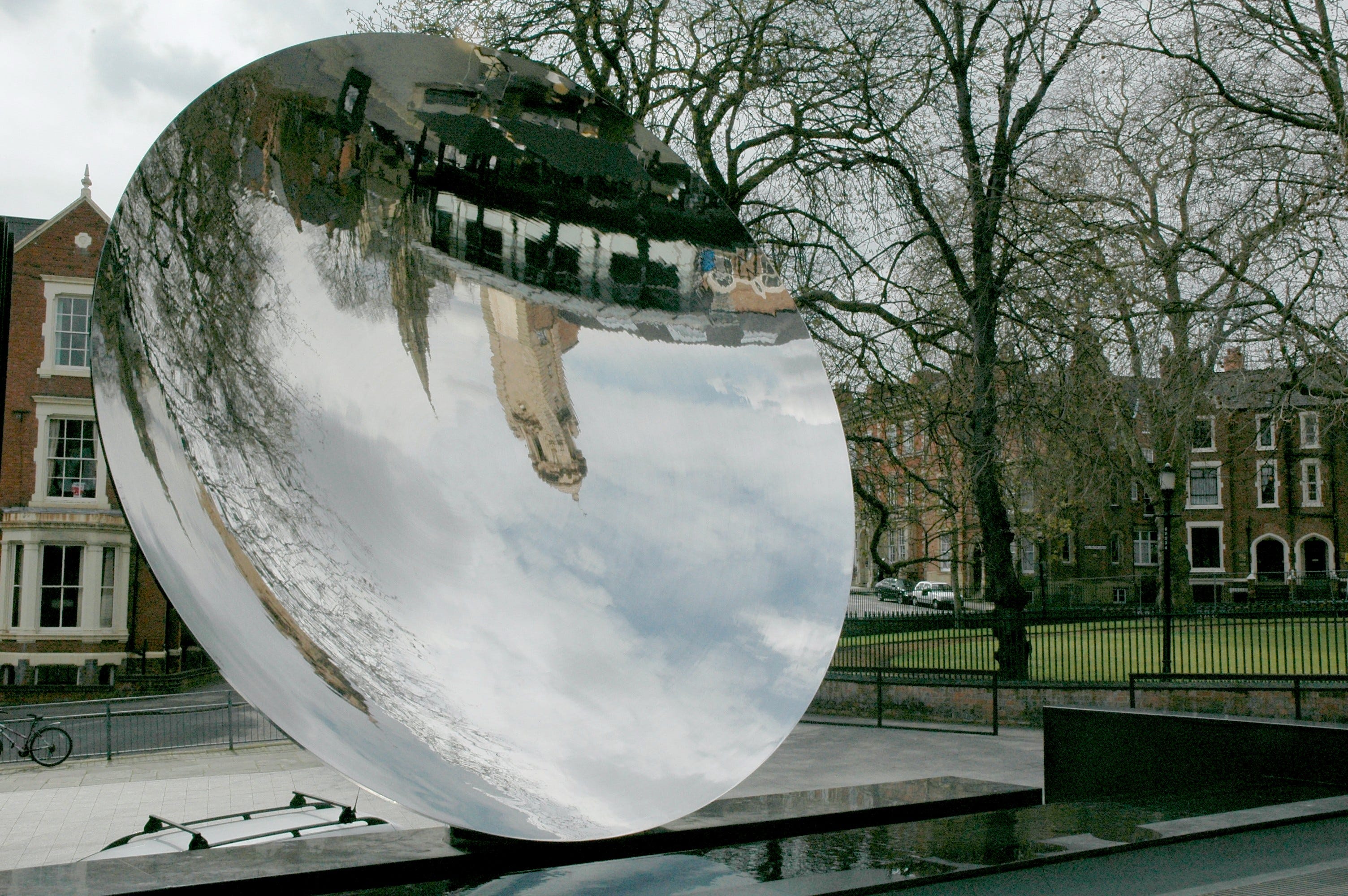
In turning more closely to Kapoor’s public works, however, it becomes clear that the artist’s own impetus for putting his work “out there” has not cohered to one central reason, but rather attended to a shifting multitude of purposes. In 2001, Kapoor debuted his first Sky Mirror, a concave mirror resembling a satellite dish, measuring 20-feet in diameter. Placed in front of the London’s Nottingham Playhouse, a modernist building which, from the exterior, sort of resembles a strip mall cluttered by cheap, lunch-break seating, Sky Mirror brought in, through reflection, the more pleasing architecture of the adjoining Albert Hall, and the neighboring Gothic Revival cathedral of St. Barnabas, now both turned upside down. Kapoor thought of this work as an opportunity to “propose a sculpture, but, in fact, make a painting,” and, indeed, it was an Impressionist image that he smuggled into the dreary plaza. Subsequent iterations, however, would borrow more from a series like Robert Smithson’s Yucatan Mirror Displacements, 1969, than, for instance, Monet’s temporal paintings of Rouen Cathedral. The pre-existing image of the environment surrounding the mirror is similarly reordered, and sky becomes ground. The Sky Mirror series departs from that of the Mirror Displacements in that they were installed in popular locations – Nottingham Playhouse, but also Kensington Gardens in London, temporarily at Rockefeller Center in New York, and at the Hermitage Museum in St. Petersburg, among others. The phenomenological effects of these works were and are experienced first-hand, rather than through photographic documentation, as in the works of Smithson, where they were arrested by the capture of photography before reaching the viewer, and then submitted to Smithson’s highly cross-disciplinary practice. In this sense, Cloud Gate may be transitional, bridging the observable effects of the Sky Mirror works with the pure functionality of the New York Bean, and its attendant role as a node of activity in the public image-economy. While Cloud Gate supposedly reflects 80 percent sky, the untitled New York sculpture reflects little beyond its viewers, or at least little we could not otherwise glean from the mirroring effects of the skyscraper to which it is affixed. Whatever else the sculpture at 56 Leonard does, whatever its functional reasons for being, it foremost signals the terminal point of this gradual drift – in the trajectory of Kapoor’s reflective public works specifically, but also perhaps more generally – from the mirror as an element of displacement to one that stages and encourages a certain form of photographic capture.
NEXT WEEK
“The Capture, Pt. 2: Phenomenological New York”