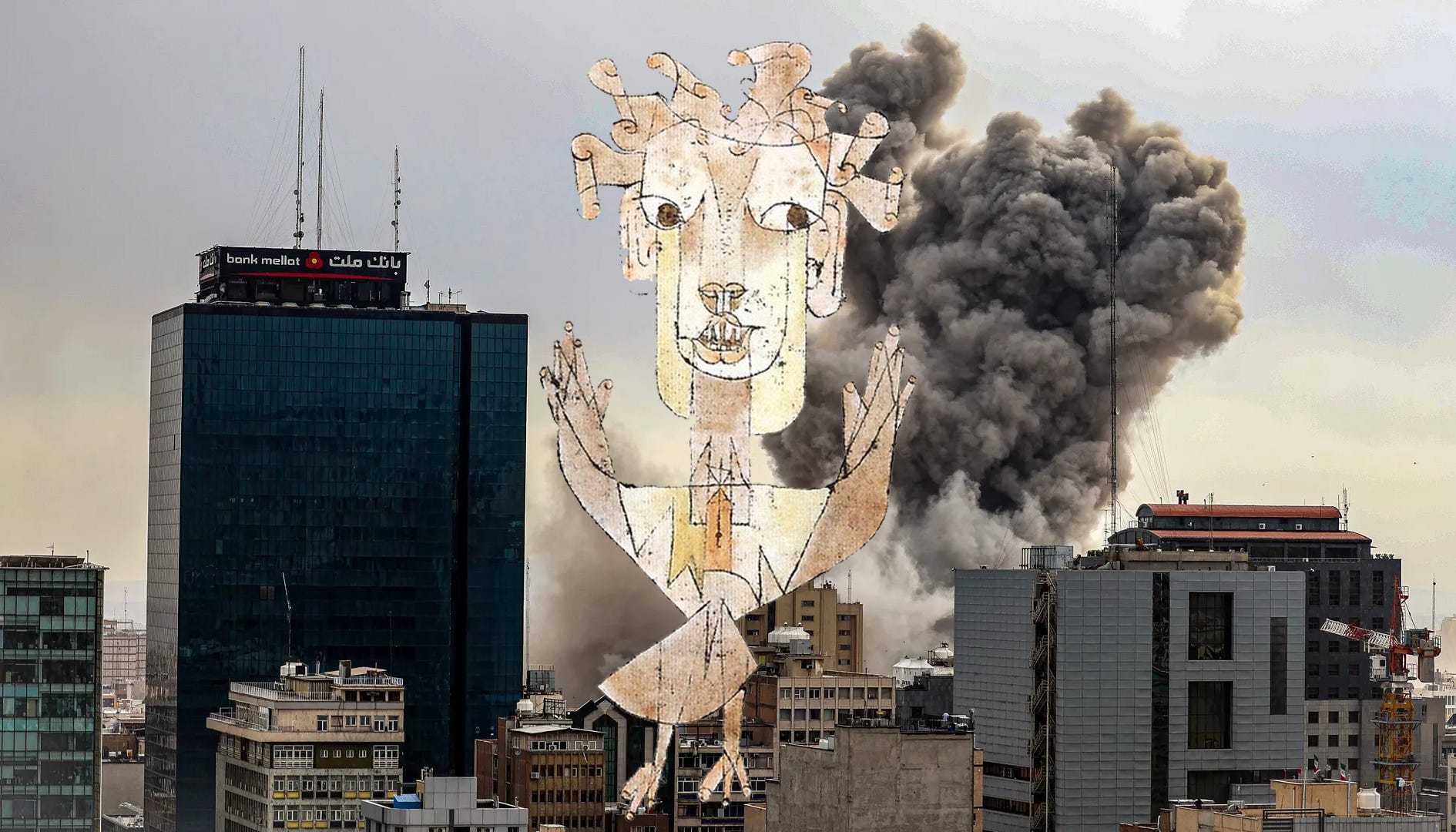
A PALMPILOT FULL OF THINGS TO DO
Short Form #4
PAUL KLEE: OTHER POSSIBLE WORLDS (JEWISH MUSEUM, NEW YORK)
I hang nobly on the wall
and look no one in the face
I’ve been sent from heaven
I’m of the angelic race.Man is good within my realm
I take little interest in his case
I am protected by the Almighty
and have no need of any face.
The world from which I come
is measured, deep and clear
what keeps me of a piece
is a wonder, so it here appears.
In my heart stands the town
where God has sent me to dwell.
The angel who bears this seal
Never falls under its spell.
My wing is ready to beat
but I would gladly return home
were I to stay to the end of days
I’d still be this forlorn.
My gaze is never vacant
my eye pitchdark and full
I know what I must announce
and many other things as well.
I am an unsymbolic thing
what I am I mean
you turn the magic ring in vain
there is no sense to me.
– Gershom Scholem, “Greetings from Angelus,” trans. Richard Sieburth, 1921A Klee painting named Angelus Novus shows an angel looking as though he is about to move away from something he is fixedly contemplating. His eyes are staring, his mouth is open, his wings are spread. This is how one pictures the angel of history. His face is turned toward the past. Where we perceive a chain of events, he sees one single catastrophe which keeps piling wreckage upon wreckage and hurls it in front of his feet. The angel would like to stay, awaken the dead, and make whole what has been smashed. But a storm is blowing from Paradise; it has got caught in his wings with such violence that the angel can no longer close them. The storm irresistibly propels him into the future to which his back is turned, while the pile of debris before him grows skyward. This storm is what we call progress. – Walter Benjamin, “Theses on the Philosophy of History,” 1940
With Angelus Novus (New angel, 1920) we enter a different realm, at the opposite pole from Ein Genius serviert ein kleines Frühstück. In this watercolor the angel materializes in midair, his body formed of interlocking zigzag lines, his oversized head, with its haunting, imperious eyes, haloed by the scroll or volute shapes that were integral to Klee’s vocabulary at the time. Angelus Novus stands for everything that was new in the early decades of the century, and for the desire to create a new humanity, a new social order, a new art. Yet the figure embodied nothing of that for a man who once owned the piece –Walter Benjamin, the great German critic, well-known for his essay ‘The Work of Art in the Age of Mechanical Reproduction’ (1936), among other works, who killed himself in 1940 while a fugitive from the Nazis. – Gert Schiff, “Klee’s Array of Angels,” Artforum, 1987
The more than forty years of commentary on Benjamin’s ninth thesis largely constitutes a continuous ideological debate about the political validation of intellectual culture among nonpoliticians. A dozen lines of printed text, conveniently focused on one picture suitable for incessant reproduction, have become a venue for drawing out a string of fundamental contradictions between revolution and religion, activism and resignation, political partisanship and historical detachment. Thus Paul Klee’s watercolor Angelus Novus of 1920 has become, on Benjamin’s rather than Klee’s terms, a composite literary icon for left-wing intellectuals with uncertain political aspirations. Benjamin’s interpretation of a ‘modern’ artwork as a mirror of autobiographical self-assurance and as a fantasy of political dissent has been turned into a foundational text for a theoretically abbreviated and metaphorically stylized alternative historical idea bent on reflecting on its own inconclusiveness. As an icon of the left, Angelus Novus has seemed to hold out an elusive formula for making sense of the senseless, for reversing the irreversible, while being subject to a kind of political brooding all the more protracted the less promising the prospects for political practice appear to be. – OK Werckmeister, “Walter Benjamin’s Angel of History, or the Transfiguration of the Revolutionary into the Historian,” Critical Inquiry, 1996
I often like to take a look at a museum’s storage room, and have seen many over the years. The work was laid out delicately with white cotton gloves on a table… There it is. Its bilateral symmetry pulled my glance straight to its central image, where I saw a winged dwarf-like creature – perhaps a baby – whose head floats in front of the waxcolored skin-like paper. He/she (zhe) demurely gazes askance into the world-distance, past its creator, Klee in 1920, past its first owner, Walter Benjamin in the ’30s, past Georges Bataille and the storms of the ’40s, past Adorno, Arendt, and Scholem in the ’60s and ’70s, past Scholem’s widow Fania Freud in the ’80s, and now, past us.
– RH Quaytman, “Engrave,” essay, 2016
To begin with there’s Angelus Novus (1920), which Walter Benjamin interpreted as the angel of history. To me, this incredibly sensitive prophet seems a little impractical as the answer to the challenges of our ignorant and murkier present time. I rather see a second angel by Paul Klee: Prickle, the Clown (1931). – Alexander Kluge, interview with Carina Bukuts, Spike Art, 2019
Did Klee want anyone to see this ‘Easter egg’? Is it a private joke? A secret confession? If Klee had wanted us to know what the engraving was, he wouldn’t have covered up so much of it. But the amount the picture reveals certainly invites viewers to wonder who lurks behind the angel... Did Benjamin suspect [Martin] Luther was hiding behind his angel?... Benjamin praised art-historical work on seemingly “insignificant” and “inconspicuous” aspects of individual works; Ernst Bloch admired his ‘sense for the peripheral,’ his ‘unique gaze for the significant detail, for what lies alongside.’ The teasing margin Klee left visible might help explain why Benjamin was so interested in this particular work by Klee. Yet no textual evidence suggests that he guessed what lay beneath. – Annie Bourneuf, Behind the Angel of History: The Angel Novus and Its Interleaf, 2022
Angelus Novus, 1920, 32
Exhibition copy. Original: oil transfer and watercolor on paper, 12½ × 9½ in. (31.8 × 24.2 cm). The original work is in The Israel Museum, Jerusalem, Gift of Fania and Gershom Scholem, Jerusalem; John Herring, Marlene and Paul Herring, Jo Carole and Ronald Lauder, New York
EXHIBITION COPY ON VIEW
Angelus Novus is generously on loan from The Israel Museum, Jerusalem. Due to current conditions affecting international transport, the shipment of the original artwork has been temporarily delayed. – Jewish Museum, wall text, 2026

IF THE WORD WE: 59TH CARNEGIE INTERNATIONAL (CARNEGIE MUSEUM OF ART, PITTSBURGH, PA)
Either by circumstance (“current conditions affecting international transport”) or design, there are fewer than half the number of artists in the 59th Carnegie International than in the last iteration, 2022’s Is it morning for you yet? This year’s title is also oddly truncated and elliptical, like refrigerator-magnet poetry or some unconvincing refrain a centrist politician might repeat on the stump. If the word we – what? It’s hard to imagine another time in which the biennale format has seemed less secure and more fraught, whether due to rising logistical costs or geopolitical tensions, or just ebbing enthusiasm for these no-paradigms, no-arguments style survey exhibitions. If the word we was yet another concept-free endeavor, ironically giving over discrete galleries to many of its artists, so that viewers were left with an overarching impression of clashing individualities rather than some form of collective or interconnected “we.”
It is by now rote to point out the latter-day biennale curator’s predilection for dead artists, but the fact that several of the departed took over entire rooms underscored the missed opportunities engendered by this strategy. One of the first distinct spaces viewers entered, for example, was dedicated to sculptures, prints, and videos by the late British artist Donald Rodney, who died young in 1998 of sickle-cell anemia. Although Rodney’s social affiliations are gestured toward lightly, by the inclusion of a short film produced by the Black Audio Film Collective, his status as founding member of the BLK Art Group is passed over by the works on view. As is any possible connection to the present: Rodney’s acerbic, postconceptual approach to sculpture reverberates with those taken more recently by artists like RIP Germain and Josiane M.H. Pozi; a few years ago, the London gallery Arcadia Missa organized a two-person show placing his work in dialogue with paintings by Janiva Ellis. As with other artists on view, the question why are we looking at this person now? could have been readily answered by reconstructing a social formation – in this case, a cross-generational “we” – around an otherwise isolated, semi-obscure figure.
Disconnection – social, spatial, temporal, aesthetic – instead emerged as one of the exhibition’s predominant themes, as demonstrated by the disparate nature of the International’s best pieces: Sarah Ndele’s video-playing masks, built from “fire-melted” plastic chairs and smartphones; Zhao Yao’s data-aggregating paintings, made from delicate strips of eggshell; Saloua Raouda Choucair’s mid-century sculptures, created in Lebanon or Michigan; Firman Ichsan’s 1990s fashion editorials for Indonesian magazines; Camara Taylor’s rum-soaked photographs; Wu Tsang’s surprisingly compelling video essay Carmen, 2024, installed in the museum’s already operatic 1907 Hall of Architecture. An errant hint of the world in which we live was provided by Li Yi-Fan’s video What Is Your Favorite Primitive, 2023, designed, like the artist’s other work, in the video-game software program Unreal Engine. The seduction of Li’s animated videos resides in the hall of mirrors effect they produce: characters hosting 3D-modeling tutorials within the 3D-animated video, turning Polaroid cameras on one another, recording themselves on smartphones against green screens. But the sense of endless potential Li conjures also appears limited to his self-referential form. Unlike the earlier machinima experiments of Cao Fei or Chris Marker, for instance, What Is Your Favorite Primitive unfolds across a suite of dingy settings evocative of late capitalist disintegration: the hikikomori-esque bedroom, the horror movie basement, the crumbling cinema house. Watching the artist’s in-video avatar perform physically infeasible stunts – mutating, multiplying, going boneless – against such claustrophobic backdrops, I found myself reminded of an old adage attributed to Michel Clouscard: “everything is permitted, nothing is possible.” That maxim, too, might have made for a more incisive International title.
DETAILS TO FOLLOW & HORIZON SYNONYM (ROMANCE / APRIL APRIL, PITTSBURGH, PA)
Also in Pittsburgh, the future Josh Kline wants: galleries led by New York directors who have left the city for the grittier, blight-ier pastures of post-industrial Pennsylvania. At least two of these spaces are very good. The first, Romance, run out of a doctor’s office by former Anton Kern director Margaret Kross, organized an exhibition in tandem with Carnegie International called details to follow. Bringing together artists drawn from a slate of galleries or project spaces based outside the US – Misako & Rosen (Tokyo), ROH (Jakarta), and Whistle (Seoul) – and pairing them with one (New York-based) artist from its own program, Romance staged a micro-International, one only a ten-minute walk from the Carnegie itself. Playfully, it also confronted the challenges of presenting global art directly; everything here was “small enough to travel by suitcase.”
Better still was the group show Horizon Synonym, put together by the Wilkinsburg space April April, a house gallery co-run by Patrick Bova and Lucas Regazzi, formerly of Nicelle Beauchene (New York) and Cooper Cole (Toronto), respectively. As with the group show at Romance, this one anthologized minor pieces by a varied set of artists, obliquely centered around the notion of art as a form of archiving. Renée Green’s pair of silkscreen prints graphically reworked lines drawn from Laura Riding Jackson’s 1938 poem There is No Land Yet; Margaret Honda presented two Retired Works, open archival boxes filled with lighting gels, film scores, and 16mm prints, coiled in canisters. Peggy Ahwesh’s the (We) Fallen, 2026, played animations reminiscent of Grand Theft Auto through a stack of CRT box monitors, raising questions about the work’s future preservation. Although the color schema here was mostly bright and saturated, each work seemed to also voice a sense of loss or an irretrievable temporal distance. And while most of the artists here exhibited multiple works, Mo Costello only showed one: Untitled (100 Broad), 2025. With its array of flower bouquets, candles, and assorted ephemera, the black-and-white print at first appears to depict a gravesite, but it instead captures another sort of memorial, this one dedicated to the now-defunct Murmur, which had been among Atlanta’s few artist-run spaces.
LIONEL WENDT (AMERICAN ART CATALOGUES, NEW YORK)
While uncomfortable to watch standing in front of an old television set at the gallery, Basil Wright’s film Song of Ceylon, 1934, makes for a decent entrypoint into the work of Lionel Wendt, who sped through at least three careers (lawyer, experimental musician, photographer; not to mention supporting roles as collector, curator, and critic) before crashing out at age 44 in 1944. Narrated by Wendt, this documentary of colonial life in Ceylon (present-day Sri Lanka) lends some needed context to a small show that otherwise gathers a handful of Wendt’s rare photographic prints. Because Wendt’s negatives were destroyed after his death, we can be sure that the images here – homoerotic nudes, meta photograms, impeccably staged still lifes – were developed by Wendt himself, restoring some of the aura photography famously lacks. For those of us first introduced to Wendt by Documenta 14, the exhibition was good news, even as it risked reducing this important work to vintage fashion photography (an accompanying essay was written by… Tyler Mitchell).
WHITNEY BIENNIAL 2026 (THE WHITNEY MUSEUM OF AMERICAN ART, NEW YORK)
Shortly after the Whitney Biennial opened in March, a gallery director I know posted a photo of Hillary Clinton in attendance, staring intently at Emilie Louise Gossiaux’s fifth-floor installation Kong Play, 2026. Gossiaux, who experienced hearing loss from a young age and later in life became blind, created Kong Play in response to the death of their longtime guide dog. The installation consists of a large ovular plinth adorned by one hundred brightly-colored, snowman-shaped ceramics, modeled after those rubber dog toys you can fill with a spoonful of peanut butter. Amused, I sent the Hillary pic to a friend, another gallerist. “Omfg, stop it,” he responded, almost immediately. “Is she looking at butt plugs?” Juvenile, yes, but good of him to imply the more interesting question: what did Hillary think she was looking at? Did she know she was contemplating ceramic replicas of a dead dog’s chew toy? Or did she see a sex-positive MFA grad’s pat rejoinder to the patriarchy? Or does she just think art today sort of looks like that, as if it were made by schoolchildren?
I began wondering what Hillary Clinton made of many other works in this year’s themeless, nameless “survey of contemporary art in the United States.” Did she recall acts of ritual diplomacy as she listened to Aki Onda’s recreation of José Maceda’s 1974 project Ugnayan, Music for Twenty Radio Stations? Did the Iranian artist Kamrooz Aram’s painting Beneath the Ruins, 2024, stir any emotions? What about a video installation by Basel Abbas and Ruanne Abou-Rahme, an artist-duo based between New York and Ramallah? Did she grimace as she watched Jordan Strafer’s video Talk Show, which coldly satirizes the final airborne moments of JFK, Jr.’s life? (“I have a PalmPilot full of things to do,” John-John flatly intones.) Wince as she looked upon Andrea Fraser’s clay sculptures of sleeping (lifeless?) toddlers? How about Isabelle Frances McGuire’s Salem witch mannequins? What did she make of of Cooper Jacoby’s own baby teeth, affixed to surveillance tech? Precious Okoyomon’s racist dolly? Did everything just kind of wash over her? Pondering all this, I kept thinking of Hillary’s clipped response to Bernie Sanders’ “America” ad, released during her second ill-fated presidential campaign. “I think that’s great,” she said at the time. “I think that’s fabulous.”
“NEW YORK REAL ESTATE AND THE RUIN OF AMERICAN ART,” JOSH KLINE (OCTOBER 195, 2026)
As another New Yorker might say, pretend it’s a city. Josh Kline’s lengthy essay for October asks us to suspend disbelief and project so many of the art world’s knotty systemic issues onto a simple cause, one we can all agree is bad and predatory in advance: New York real estate. Because this essay is somehow both trenchantly descriptive of real problems (austerity measures at the museum or kunsthalle, high overhead costs for galleries, a speculative and uninterested collector class) and woefully circumspect when it comes to the blame game, it has been applauded by a pseudo-critical audience I believe also knows better. (For no particular reason, you may download a PDF from maxwellgraham.biz.) Symptomatic of a hyperpolitical culture in which stating the obvious counts as parrhesia and any form of political action is foreclosed in advance, “New York Real Estate and the Ruin of American Art” offers few alternatives, mostly reminding us of yesteryear’s notorious bromide – there is no alternative.
If you agree, however, with the central premise, and imagine some organizing might be done around the (rather narrow) impasses of municipal bylaws and tax codes and zoning regulations, think again. “The structural conditions in New York City that have transformed the art world into the art industry are largely beyond the power of artists to change,” Kline laments. “Artists will not be able to lower the value of real estate in Manhattan, Brooklyn, or Los Angeles.” (LA is bizarrely treated as a sixth borough throughout). “Nor will they be able to alter the tax regime in a place like New York that makes it more lucrative to leave vacant commercial real estate empty than to rent it at lower prices. They can boycott expensive grocery stores, restaurants, and bars, and they can forgo designer clothes, but they will not be able to lower the fundamental cost of living in New York City, which is driven by the high rents and high cost of doing business.” Even if artists shun Happier Grocery and Frenchette and Café Forgot, the cause is essentially lost. It all reads as a sort of Whitney Biennial of the mind.
Meanwhile, in a concluding section, helpfully titled “Alternatives,” Kline ruminates on some potential options. Move to Philadelphia! Make some really big sculptures in an empty warehouse! Or, no… time travel back to 1990s Olympia! Become a riot grrrl. Charge for drinks at your scrappy DIY opening, as art collectives in Indonesia do! Wait… how about this? Graduate from RISD or Brown, saddle yourself with debt, but then stay in town, in Providence, play in a noise-rock band, start an art collective like Paper Rad! Remember Lightning Bolt? Marcel Dzama? Takeshi Murata? Wasn’t that all kind of… fun? Of course, I’m being slightly facetious, but these are more or less the solutions proffered to young artists, ostensibly the intended readers of this nineteen-page essay, buried, for most art-school undergrads, in a paywalled academic journal. Techno and house progenitors in Detroit and Chicago, “underground hip-hop scenes” in “San Francisco, Philadelphia [again], Baltimore, New Orleans, Houston, and Atlanta”: “all of these communities prized authenticity and viewed selling out [emphasis Kline’s] as a great evil.” Here is the sort of meaningless, feel-good riff Helen Molesworth’s editors might have cut a decade ago. And once again, we must think of Thatcher – what alternative, whose? We will not, however, be thinking of Aaron Shkuda’s The Lofts of SoHo or Martha Rosler’s Culture Class or Sharon Zukin’s Loft Living or any other attempt, recent or not, to historicize the confluence of artistic activity, urban planning, and gentrification in New York. That could get a bit complicated, no? Not very Wham City.
The principal bad actor of this piece (and perhaps the only named actor), is the artist Christopher Wool, who in 2024 rented the vacant nineteenth floor of an office building in the Financial District and staged his own third-act survey See Stop Run. Because the show was self-initiated and self-funded, and because it included works previously shown in a commercial gallery, at Xavier Hufkens in Brussels, the implication was that Wool’s New York galleries viewed this endeavor as a bad investment. Accompanied by the public knowledge of Wool’s tanking auction sales and the general aversion toward his brand of “post-gestural” abstraction, the show seemed to make the amusing, self-deprecating point that Wool, and maybe other blue-chip artists of his ilk, were a lot like commercial real estate in New York, post-pandemic: exorbitantly priced, unsalable, and yet still stubbornly there. The show also employed a number of (young-ish) artists throughout its duration and commissioned a new play by Richard Maxwell, who in turn gave his makeshift stage over to a cast of mostly young actors, some of whom were also moonlighting artists. Yet to Kline, Wool’s show was merely “LARPing as a kind of Epcot Center version of downtown New York”; the latest in a series of “expensive, luxury reenactments of a punk past no longer available to the kind of young artists from working-class or middle-class backgrounds who, once upon a time, helped forge the template for this type of space.”
I might argue instead that Kline’s essay performs the exact function it assigns to See Stop Run: lamenting the demise of a certain kind of New York in the pages of October, best known for its canonical essays of the 1970s and 80s, “New York Real Estate and the Ruin of American Art” addresses its appeal to a readership more accustomed to the conventions of the last century than ours, nostalgic for their salad days, more familiar with Nature Morte and the Mudd Club than 47 Canal, let alone 356 Mission or O’Flaherty’s (or Earth, to name just one active artist-run space Kline doesn’t). It suggests that the “canonical breakthroughs in art that occurred in the 1960s and ’70s in New York – Conceptual art, video art, performance art, Minimalism, and so on” were cultivated by the low cost of city living during this period, without acknowledging that most of these “breakthroughs” were also born of significant material constraints. (Even living members of the ‘80s Mudd Club crowd might celebrate their predecessors’ resourceful ingenuity.) “In their lofts, studios, and artist-run spaces, two generations of very fortunate artists turned art upside down over and over again, reinventing and revolutionizing it in the endless free time that the era’s low rents made possible,” Kline writes. This narrative comes across either as an ahistorical fairy tale or as a desperate plea to the entrenched Boomer class, but, in each case, I think we should reject it.


